
Why we are building a notice board for villages
Nearly every German village has one: the notice board at the town hall, at the village shop or at the bus stop. It says when the fire brigade drills, when the council meets, which road will be closed and who is inviting everyone to the harvest festival. It has worked for generations – on one condition: you have to walk past it.
That is exactly where it breaks down. Whoever commutes to work no longer passes the board. Whoever moved in recently does not know it exists. And anyone under thirty does not get their information from a sheet of paper behind glass. Every village knows the result: the sports club looks for new members and finds none. The village fête is organised by the same twelve people as last year. Not out of indifference – but because the information never arrives where people are looking.
That is why we are building dorfbrett.de (in German).
What it is
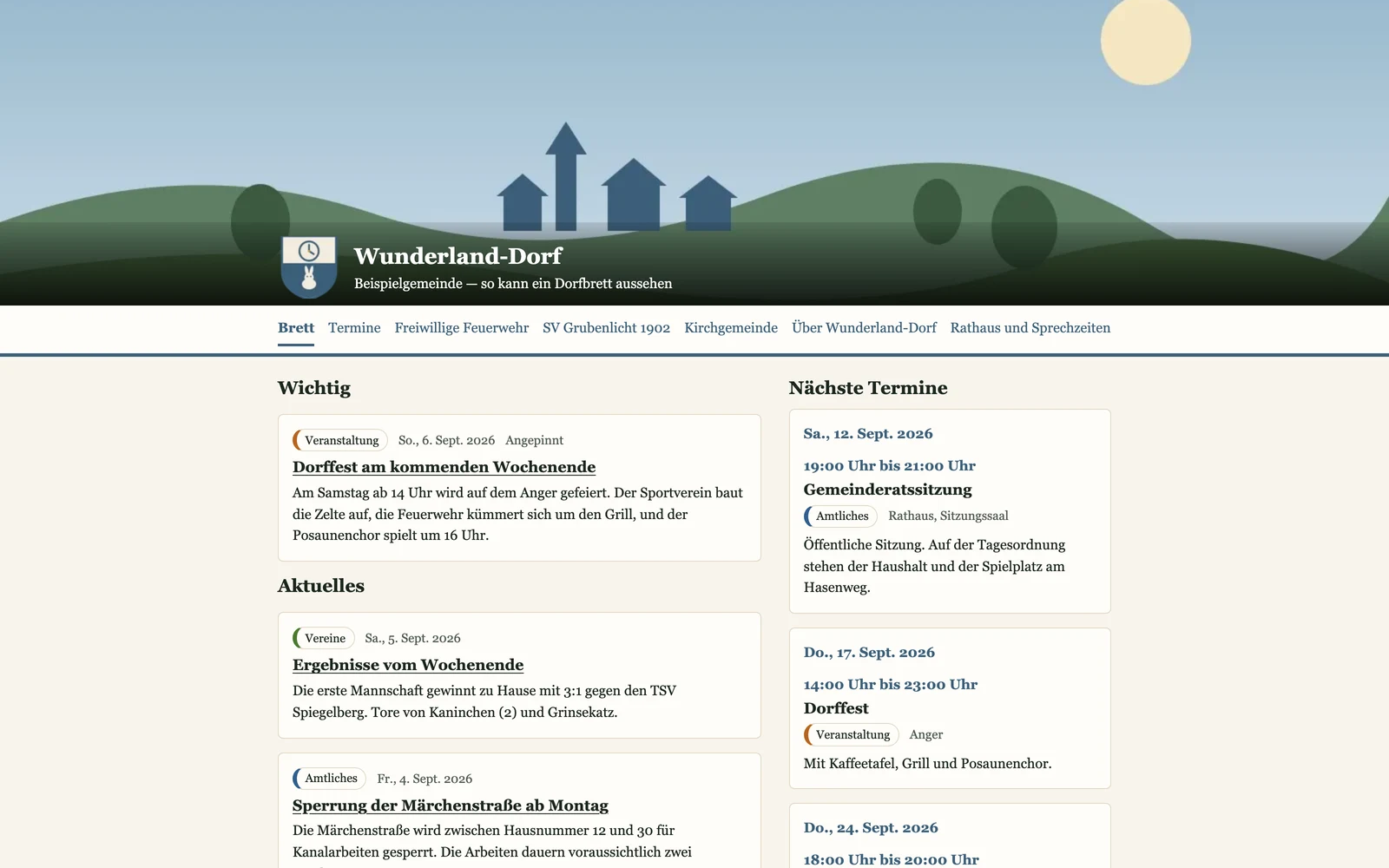
Every municipality gets its own page: posts, dates, separate sections for the fire brigade, the clubs and the parish, plus fixed information pages such as the town hall’s opening hours. Whoever enters something fills in a form – no CMS, no training, no jargon. Who may do what is decided by the municipality itself: administration, editing, or writing posts only. So the fire brigade looks after its own section without anyone at the town hall retyping every notice.
The result is an address you can write on a slip of paper. Every municipality also gets a QR code – including a ready-made A4 poster. That goes up on the real notice board, and whoever holds their phone against it in passing has the whole content in their pocket. The old board is not replaced; it gets an extension.
What that looks like is shown by our example municipality Wunderland-Dorf – fully set up and openly accessible.
What we pay attention to
It has to be reachable. The public side is static; it hangs on no database and no login server. If our administration side goes down, the dates are still there. For a municipal page that is not a detail – if the road closure is unavailable exactly when everybody is looking for it, nothing has been gained.
It stays in Germany. No American services, no foreign CDN, no externally loaded fonts. A municipality informing its citizens should not send its readers’ data halfway around the world as a side effect. For us that is not a marketing line but the reason we run everything ourselves.
It has to work without us. If a municipality has to phone us for every change, the project has failed. A setup assistant walks through the mandatory details once; after that the municipality works on its own.
What we hope for
In the end this is not about software but about belonging. A village lives on people joining in – in a club, in the fire brigade, at the fête. But you can only join in if you find out there is something to join. For the generation that is between fifteen and thirty today, that finding out happens on a screen, or it does not happen at all.
We do not believe a website saves a village. But we do believe that the hurdle between “if only I had known” and “count me in” often consists of nothing more than one missing piece of information – and that can be fixed.
For municipalities
Dorfbrett is ready and we are looking for pilot municipalities. The first six months after activation are free; after that the prices start at a figure that does not require a second council meeting. The details are on dorfbrett.de – and anyone who would rather ask first can reach us through the contact form.